"Undermining my electoral viability since 2001."

Blue Language

Shit, how did I miss this?

Blue Language is a live double-album from some of the most talented people I've had the distinct priviledge to hear perform in the great underground cultural mecca that is Portland, Oregon. If you have any sort of taste for acoustic music with wit, you should
give it a listen on CDbaby. Then buy it. I did.

Read More

Tags: 

Hustle and Flow

Via the bliss of Bittorrent, I watched Hustle and Flow last night. It's good! MTV films is a hit-or-miss operation, but this is a real winner. I've been meaning to see it since I met (rather was picked up by) the assistant location manager in Memphis on the road this summer and los Vagabenderosos spent a day with her parents (her mom was the Memphis location hefe), but never got around to it.

The movie essentially rests on the shoulders of Terrance Howard, and he carries it with style and grace. He really makes you believe that a Pimp can be a good man, and really makes you want to pronounce "man" like he does, kinda like, "main." The rest of the cast is quite good as well, even the token nerdy white kid producer. It's a bit of a cinderella story, and the Moral Majority would see it as bedrock proof that hip-hop, MTV and "those people" are out to ruin the US of A, but it's thoroughly enjoyable and even a little bit moving.

It's also really nice to see a little bit of the Dirty up on the big screen. I think the rising cultural gravity of the South is a good thing overall, CMT included. Regionalism helps drive innovation, quality, etc, and frankly I think the old-line cultural centers (NYC, Hollywood) need competition. They're getting fat and lax. I also appreciate the re-appropriation of the verb "to hustle" and the noun "hustler," which I think have a lot of potential in postmodern America.

Hustle and Flow, people; thoroughly worth your netflix/rental dollar.

Read More

Tags: 

Proportional Representation

Back in the heady days of Deanism, one of the things I was harping on was how one of the problems we have in governance these days was the ratio of representation. Congress is currently 666,000:1, up from 50,000:1 back in 1800.

Makes for an interesting graph, if I do say so myself.

At some point there will be a realignment of these ratios if representation is to continue to be effective.

Read More

Tags: 

Changing Norms

Amanda at Pandagon writes well about changing norms, and how they may the the genesis for a lot of the current culture war hullabaloo:

It occured to me while we discussed this that this sort of thing probably goes a long way to explain why right wing blather about "traditional" families has really gained such a toehold in the public arena lately. For all the attention pain to the Baby Boomers who were into the counter-culture and whatnot, the vast majority of them really did make an effort to create the sort of family life they were raised to believe was standard--young marriage to a high school sweetheart, children, working hard, saving, enjoying some retirement time with the grandchildren. The dream didn't work out for a lot of people as planned, as the high divorce rate is evidence for, but they at least tried. But then they look at their kids who are really becoming full adults and a whole bunch of us clearly don't even care to try to achieve the dream.

For my part, I didn't grow up in any sort of traditional household, but I find the theory interesting. Worth reading and thinking about at any rate.

What I wonder about is this: it's not as though norms are simply disappearing. They may be factionalizing, national consensus on the wane, but the whole area of Family is too socially important for communities to not exert a norming influence. What's the new model, or what are the new values?

Read More

Tags: 

Iraqi Election Results

I've been watching the results of the elections in Iraq with some interest. I'm still not sure where the Kurds are at with everything. Some news suggests they're onboard with the Shia Islamic alliance that swept into near-complete control; at the least I haven't seen any news about Kurts protesting the results as Sunnis and non-theocratic Shias have been. I'm not sure how their position is looking in light of everything.

And now this:

It has long been suspected that Sunni Arabs are severely underrepresented in the new military and police.

But the new voting results, which elections officials say include most of the ballots cast by Iraqi military and police, are a sign of how complete the reversal of the fortunes has been for the Sunnis, who ran those security forces under Saddam Hussein.

Basically it would appear that the Iraqi army and police we are equipping are a completely different population of people than the Iraqi army that we disbanded after invading the country. You wanna know what that means? There there are two armies in Iraq.

UPDATE: via John Robb, the Times is now reporting that 45% Iraqi Army votes went for Kurdish candidates. 40% went Shia. Curiouser and curiouser...

Read More

Iraqi Election Results

I've been watching the results of the elections in Iraq with some interest. I'm still not sure where the Kurds are at with everything. Some news suggests they're onboard with the Shia Islamic alliance that swept into near-complete control; at the least I haven't seen any news about Kurts protesting the results as Sunnis and non-theocratic Shias have been. I'm not sure how their position is looking in light of everything.

And now this:

It has long been suspected that Sunni Arabs are severely underrepresented in the new military and police.

But the new voting results, which elections officials say include most of the ballots cast by Iraqi military and police, are a sign of how complete the reversal of the fortunes has been for the Sunnis, who ran those security forces under Saddam Hussein.

Basically it would appear that the Iraqi army and police we are equipping are a completely different population of people than the Iraqi army that we disbanded after invading the country. You wanna know what that means? There there are two armies in Iraq.

UPDATE: via John Robb, the Times is now reporting that 45% Iraqi Army votes went for Kurdish candidates. 40% went Shia. Curiouser and curiouser...

Read More

Spartan: Total Warrior Review

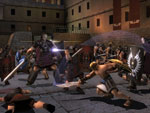
A while back I did a blog post about my experience playing The Warriors. The blogsphere being what it is, someone working for a viral marketing firm saw it and wanted to know if I'd review another game if she sent it to me. "Sure," I said, and why not? Seems like the thing to do. A few weeks and emails later I got a copy of Spartan: Total Warrior from Sega. Here are my impressions.

Overall Rating: The Gentleman's B

In Brief

spartan total warrior

In a nutshell, Spartan: Total Warrior has a very playable combat system, decent graphics and sound, and some interesting effects, but suffers badly from a lack of depth. It's good, clean hack'n'slash fun, and the levels which contain more complex objectives -- lending an element of puzzle-solving or battle management to things -- are especially engaging, but as the game rolls on it wears a little thin. The story doesn't provide much juice, and the only novel developments in gameplay come from unlocking new weapons, which are few and far between. In the end, it starts to feel like work to battle your way through.

The Good:

The battle system is the game's heart and soul, and it's a good one. You have standard attacks, blocking and ranged (arrow) attacks. There are individual and sweeping/group variations for all these, which provides a good foundation for combat. Additionally, you can build up bloodlust to execute special melee attacks, and collect the souls of those you've slain to execute various magic effects. The magic attack is determined by your choice of weapon, and also has both individual and group/area varieties.

All this adds up to a pretty complex control system, but it's one which mostly works. There's a strong rhythmic component to the action; it's all about getting on a good roll. When you succeed in getting a good run, you can launch regular bloodlust attacks, and making lots of kill means collecting lots of souls which lets you unleash your magic as well. Aries God of War will give you some verbal encouragement if you give him enough carnage, which is a nice touch.

There are also a decent variety of opponents. Though they seem to come in a standard series of classes, there's enough variety to make you learn to use your shield, with the additional feature that you can use it both offensively as well as defensively. Sophisticated opponents will use their own shields, so especially in later levels it becomes necessary to shield-bump defensive enemies to open them up for your attacks.

There are some points where the maps feel a little bit blocky -- "shouldn't I be able to jump over that?" -- and the camera can occasionally get locked in a position that makes combat tough, but overall it's a good engine with great potential for gameplay.

The Bad:

Which it's unfortunate that the game doesn't go much beyond the core combat engine. There are no other significant elements. All that the game's "secrets" unlock are concept art (concept art?) and additional elements for the arena mini-game, which doesn't offer anything over the regular game experience. The "ability system" is so simple it's practically pointless. There is no two-player mode or ability to call tactics for your in-game allies. There isn't even an item system.

It seems like the folks who designed this game have missed out on most of the innovations of the past few years. It's almost anachronistic. The story isn't interwoven into the mission structure very deeply. There is no skill tree to ascend, no strategic element at all. While new enemies and weapons are added with each act, they can't alone provide enough to make the game a real winner down the stretch.

In Conclusion

When you look at leading titles in the genre, they're all bringing something extra to the table. The Warriors has all the action, but it's also built around a strong narrative story and a cast of characters that keep things interesting and moving forward. X-Men Legends has a similar hack'n'slash style, but has such depth in terms of character development to qualify as a genre-crosser in the RPG category. The Dynasty Warriors franchise, which helped break open this kind of gameplay in the first place, is built around a strategic simulation/management game.

In spite of it's top-tier combat engine, Spartan Total Warrior lacks any of these additional facets, which is why it gets only the gentleman's B.

Now, I don't know if this means I'll get any other games to review, and I don't know if anyone will buy this game as a result of this blog, but it's an interesting experiment in marketing. In aggregate, it's definitely better for the health of the industry to diversify the sources of opinion on what's playable and what's not. I'm happy to contribute to that in my own small way.

Read More

Tags: 

Little Red Hoax

Apparently the kid at UMass who claimed to have been checked up on for checking out Mao's Little Red Book was making the whole thing up. That's a relief.

Read More

Tags: 

Merry Christmas Weekend

wreath

Well, I'm going to take the weekend off. Lucas and I are gonna watch some college football. I'm gonna explore Prospect Park. Maybe I'll even eat some ham. I hope you and yours are warm and happy.

Read More

Tags: 

Ramble: Spying, Substance, Communications Strategy

Here's my morning news ramble. Turned into a long one, so see if you can stick with me. I especially liked the end, but I'll beat that drum some more on that so don't worry if you tune out right now.

Spying; Everyday People
It's looking more and more like COINTELPRO again:

The officers hoist protest signs. They hold flowers with mourners. They ride in bicycle events. At the vigil for the cyclist, an officer in biking gear wore a button that said, "I am a shameless agitator." She also carried a camera and videotaped the roughly 15 people present.

This hits close to home because this is a community to which I've a number of connections Say it with me now: Critical Mass is not a threat to national security. There's no need to secretly videotape their activities.

If we don't turn back from this, it's going to get worse. This sort of relationship between the State and its dissidents, like any fight, has a way of escalating. It starts with the State treating dissenters as threats, and usually ends with violence. I'd rather not go there.

This is why having a just, working and equitable system of law and democracy is important. Not just because it's the morally right thing to do, but because the only way to go from there is down.

The problem is that it doesn't take a rocket scientist to recognize that we're somewhere short of a "just, working and equitable system of law and democracy." The $64,000 question is whether there's enough vitality and virtue left within our systems to make reform possible, or whether that's just a big waste of time.

To some radicals and activists, the behavior of "everyday people" ranges from incomprehensible to repugnant. Among people who are non-activist but on their way up in society (e.g. a lot of my friends who made it through college), the idea that "everyday people" are too stupid to realize what's in their best interest is remarkably pervasive.

This bears directly on questions about "the health of the system." If one does not believe that "everyday people" are capable of self-governance, there's not much point in democracy.

Individuals are remarkably fallible, but when engaged in large numbers I think people tend to get it right. In almost all cases, mass participation produces better results than "expert" direction. This is what underlies the argument that market economies are better than command economies, and it's the right idea.

The American Left must find a unifying philosophy which incorporates a populist message. Many are wary of this because they see the example of the GOP and assume that populism means manipulating people through fear. They think that populism means propaganda, demagoguery, stirring up anger and resentment.

While it's true that all these negatives have been part of populism in the past, it's not as though the only way to engage mass amounts of people is by turning them into a mob. The New Deal stands as a great example of this.

Substance
As Max Swacky points out in a post about the need for research and wonkery, even when Democrats are out of power:

We need propaganda and agitation, but to give the public something substantive that it can take to heart is the basis for progressive transformation of society. That's what winning is all about. Otherwise we're looking [at] a rotating bands of miscreants, alternatively taking office, raiding the till, and getting thrown out by the next cohort of miscreants-to-be.

If you don't think the Democratic Party doesn't have the same potential for lyin, cheatin, and stealin, you are gravely misinformed. The only constraint on the abuse of power -- besides an opposition lurking in the wings -- is an engaged, informed public. Being angry and stupid isn't good enough.

This is essentially right, although I still don't think people are just "angry and stupid" at the moment.

What Max doesn't seem to acknowledge -- though I'm sure he realizes this -- is that there's a lot more to "giving the public something substantive that it can take to heart" than doing research and publishing papers, even if the papers do get read by congressional staffers. In fact, I would say this is a critical lesson to take away from the Clinton Years, which were a golden age for wonkery, true, but one in which fucking nothing substantially progressive happened and one in which the country's overall politics shifted notably to the Right.

There currently exists no channel by which the substantive fruits of research can be widely and effectively communicated to the public. You can say that the public would rather watch The Apprentice, and you'd be right in terms of pure popularity for how to spent one hour. You could also say that the press is manifestly failing in bringing the truth to the fore, and you'd also be right; just look at the "debate" over Intelligent Design if you need an example.

However, the fact remains that at the moment there's no channel for the public to engage with substantive research, even if they want to. There's no-one distilling and humanizing the voluminous data about reality. That's reality -- information about our world and what we might be able to do about it -- as opposed to politics, where the blogosphere seems to be getting traction. Since 2002, there are many many more people who are informed and astute about politics in America, that's largely due to the blogs slowly raising the discourse out of the gutter of talk-radio and providing a relatively nutritious alternative to the high-fructose corn syrup spectacle of cable-news infotainment.

However, most of reality remains a mystery to many, something that needs to change if we're to have better governance in addition to better politics. Of course, a large part of this is our education system, which manifestly fails to inform, inspire and stimulate millions of children every year. It's a long term problem, but we can't just lay it all on the kids. After all, it's not as though grown-ups are close-minded robots. Brain plasticity decreases over time, but it's not as though people can't learn, can't grow, can't evolve and change throughout their lives.

Communication Strategy
What I want to know is why no one learned anything from Ross Perot. That crazy (and arguably fascist) motherfucker went on TV and explained shit to people, and it worked like gangbusters. Had he not gone loopy in the midst of things -- dropping out of the race because he was convinced that government agents were going to somehow ruin his daughters wedding, if I recall -- he may in fact have won.

It's worth noting that Perot and his Reform Party began by tapping into a latent base of isolationist conservatism -- the Lou Dobbs/Pat Buchannan faction -- that wasn't being addressed by either Bush Sr. However, at points in 1992, Perot led the field, indicating his support had broadened significantly. I've seen analysis that he took as many votes from Clinton in the end and I believe it. My mother was a Perot fan, along with 12-year-old me. I think this was a result of his strategy of communicating large amounts of information in a relatively complex manner to as many people as possible, and trusting that people would understand and agree with him.

In 1992, only a self-financed billionaire or major campaign could possibly afford the massive amounts of TV time required to implement such a strategy. By now things have changed significantly.

If someone gave me little seed capital I would get several good videographers, pull together some of the better research, create a series of 20-minute infomercials, put them online, and run a high-quality ad campaign to drive people to that site. We would gather donations from visitors to run the infomercials nationally or in certain markets. We could even provide instructions and materials for individuals or groups with resources to run the ads in their own markets.

This would work. Here's how you do it:

  1. Create a message, grounded in solid research
  2. Translate that message into a persuasive media package
  3. Initiate a strong broadcast campaign for the media package
  4. Direct receivers of that broadcast message back to a community with both online and offline presence
  5. Allow the community to improve the research, message and media packaging
  6. Allow the community to disseminate the above both on a grassroots level and through fundraising for more broadcasts
  7. Lather, rinse, repeat

There's your 21st Century message strategy for a 2008 presidential campaign. You can send me my six-figures via paypal.

Now, you'll still need rapid response, an attack strategy and all that jazz. You'll also need to make sure that original message is good (which will cost you another six-figures), but this is how you can effectively get your word out, maybe at a net profit for your campaign if it's good enough. This is essentially a focused and media-savvy version of what the Dean campaign did that allowed it to grow so rapidly and drive such high rates of online donations. It wasn't online magic. It was online magic plus outstanding message plus participation-oriented organization.

This would probably work on the national level for the 2006 midterms. The combination of real information, participatory discussion, and the promise of power to put the fruits of those to into practice is the secret sauce, so in '06 this would require some entity with national authority (or the perception of national authority) to back the play. A 2006 equivalent to the congress-in-waiting that Gingrich et al put together in 1994; an entity with power.

I don't know if such an entity will emerge; frankly, I think the odds are against it. It would almost have to be a joint Pelosi/Reid effort, and although both are doing very well all things considered, I don't see them as being this ambitious.

It looks to me like 2006 is going to be a DIY year for the revolution. Nothing new there. Who's down?

Read More

Tags: 

Pages