"Undermining my electoral viability since 2001."

Quality and Generosity and Health Care

Picking up on my last post:

You do what you do because you like doing it. Because you like doing it you do it well. Because you do it well, it's valuable to other people.

In a clinical analysis, there's no real need for thankless labor anymore, though with our industreal-era habit of massive over-consumption quite a bit of it still exists. As a society we're trapped in a dead-end way of thinking, but the current People In Charge are deadly afraid of allowing different ideas to be taken seriously. Such an undertaking, while perhaps getting closer to the truth, might jeopardize their position.

An example: in my previous post on health care, my friend A-Stock (also named Alex, but another friend named Alex already commented) wonders how a better system might come into being. My other friend Nick responds in girthly fashion and is, I think, essentially correct. But I want to kind of elaborate on what's going on here.

First of all, the question of paradigm. In response to the observation that Americans spent more than twice per-citizen on health care as any other nation in the world, yet still manage to have middling life expectancy and close to 50 million citizens with no coverage, Alex asks "How do you pay for [health care for more people]?"

The answer is we're already paying for it. In fact, we're paying double. The question is not how does one pay to get quality health care for all citizens. The question is who do you pay.

Now, what do I suggest? I suggest we not be shy about picking up a good idea and implement a standard single-payer system for all general coverage: preventative care, dental, and anything you need to stay alive at a minimum. We can haggle over "quality of life" costs (hip replacement, viagra, etc) all day long, but covering the basics is a no-brainer and there's no reason not to do it.

I suggest we call health insurence what it is: a trickle-up system of extracting wealth from working/middle-class families and seniors. Insurance companies are out to make money, and the market doesn't have any problem using human suffering and weakness to drive profits. Remember the market doesn't give a shit about people or society. Is it right for health insurance profits to skyrocket as medical coverage declines?

I suggest we remove inefficient and corrupt profit-taking beureaucracies from health care administration as well. Medicare runs about 3% in administrative overhead. HMOs are somewhere between 4 to 15 times as wasteful. Why are we tolerating this drain on our economy?

I also suggest we allow collective bargaining with pharmaceutical companies on drug prices. To make up for any lost profits, we can prohibit marketing and doctor-lobbying for prescription medications. Free speech is not a right to advertise, and prescription medications should be recommended by doctors, not hyped directly to consumers. The US and New Zeland are the only countries that allow this practice; maybe we should rethink it. Cutting the ad budget will remove about $2.5B in costs for the pharmaceutical industry, which should provide a healthy boost to their bottom line.

To sum up, I suggest we give businesses an effective tax break and provide workers with a bigger paycheck and more peace of mind by making health care efficient and decoupling it from employment. Our immigrant population won't wreck the single-payer equation. This problem can be solved. Even if we're not as efficient as the Germans or Japanese, we can still give workers and businesses a boost to their bottom line while simultaniously providing coverage to the millions of uninsured.

In today's political environment, this is a somewhat radical ideas, but it shouldn't be. It's just the truth.

Update: J-Chow (Gotta Drop A Blog), the voice of reason:

yes, something needs to be done, but the solution is not simple because it involves a large number of people giving up power, perks, control, and money. it also involves people (the general population) becoming less apathetic and focused on others (instead of our own selves). this will be the hardest part of the process.

I too don't think the solution is simple. I think there are ways to innovate. For instance, why not have single-payer coverage for general health care with private coverage (maybe even "Health Savings Accounts") for elective and quality-of-life costs. Couple that with a redoubled investment in R&D, total transparency in accounting, and a system of oversight and governence that doesn't put CEOs, bureaucrats (corporate or government), politicians or union bosses in the drivers seat, and that's getting to sound pretty sweet. I'd settle in the short term for not having health care tied to a job, bringing down costs so give small businesses a break, and covering people who are really in pretty desperate need.

Read More

Tags: 

Quality and Generosity and Health Care

Picking up on my last post:

You do what you do because you like doing it. Because you like doing it you do it well. Because you do it well, it's valuable to other people.

In a clinical analysis, there's no real need for thankless labor anymore, though with our industreal-era habit of massive over-consumption quite a bit of it still exists. As a society we're trapped in a dead-end way of thinking, but the current People In Charge are deadly afraid of allowing different ideas to be taken seriously. Such an undertaking, while perhaps getting closer to the truth, might jeopardize their position.

An example: in my previous post on health care, my friend A-Stock (also named Alex, but another friend named Alex already commented) wonders how a better system might come into being. My other friend Nick responds in girthly fashion and is, I think, essentially correct. But I want to kind of elaborate on what's going on here.

First of all, the question of paradigm. In response to the observation that Americans spent more than twice per-citizen on health care as any other nation in the world, yet still manage to have middling life expectancy and close to 50 million citizens with no coverage, Alex asks "How do you pay for [health care for more people]?"

The answer is we're already paying for it. In fact, we're paying double. The question is not how does one pay to get quality health care for all citizens. The question is who do you pay.

Now, what do I suggest? I suggest we not be shy about picking up a good idea and implement a standard single-payer system for all general coverage: preventative care, dental, and anything you need to stay alive at a minimum. We can haggle over "quality of life" costs (hip replacement, viagra, etc) all day long, but covering the basics is a no-brainer and there's no reason not to do it.

I suggest we call health insurence what it is: a trickle-up system of extracting wealth from working/middle-class families and seniors. Insurance companies are out to make money, and the market doesn't have any problem using human suffering and weakness to drive profits. Remember the market doesn't give a shit about people or society. Is it right for health insurance profits to skyrocket as medical coverage declines?

I suggest we remove inefficient and corrupt profit-taking beureaucracies from health care administration as well. Medicare runs about 3% in administrative overhead. HMOs are somewhere between 4 to 15 times as wasteful. Why are we tolerating this drain on our economy?

I also suggest we allow collective bargaining with pharmaceutical companies on drug prices. To make up for any lost profits, we can prohibit marketing and doctor-lobbying for prescription medications. Free speech is not a right to advertise, and prescription medications should be recommended by doctors, not hyped directly to consumers. The US and New Zeland are the only countries that allow this practice; maybe we should rethink it. Cutting the ad budget will remove about $2.5B in costs for the pharmaceutical industry, which should provide a healthy boost to their bottom line.

To sum up, I suggest we give businesses an effective tax break and provide workers with a bigger paycheck and more peace of mind by making health care efficient and decoupling it from employment. Our immigrant population won't wreck the single-payer equation. This problem can be solved. Even if we're not as efficient as the Germans or Japanese, we can still give workers and businesses a boost to their bottom line while simultaniously providing coverage to the millions of uninsured.

In today's political environment, this is a somewhat radical ideas, but it shouldn't be. It's just the truth.

Update: J-Chow (Gotta Drop A Blog), the voice of reason:

yes, something needs to be done, but the solution is not simple because it involves a large number of people giving up power, perks, control, and money. it also involves people (the general population) becoming less apathetic and focused on others (instead of our own selves). this will be the hardest part of the process.

I too don't think the solution is simple. I think there are ways to innovate. For instance, why not have single-payer coverage for general health care with private coverage (maybe even "Health Savings Accounts") for elective and quality-of-life costs. Couple that with a redoubled investment in R&D, total transparency in accounting, and a system of oversight and governence that doesn't put CEOs, bureaucrats (corporate or government), politicians or union bosses in the drivers seat, and that's getting to sound pretty sweet. I'd settle in the short term for not having health care tied to a job, bringing down costs so give small businesses a break, and covering people who are really in pretty desperate need.
Read More

Tags: 

Blogging is Generous

Shorter Atrios:

It's not about your ego. It's about getting something accomplished. Do it for the love of the game.

Which is why I much prefer his and Markos' style to that of Anna Marie "I write so people will pay attention to me" Cox (aka Wonkette); it's more generous, not to mention more substantive.

I believe in a world of Quality and Generosity: you do what you do because you like to do it; because you like to do it you do it well; because you do it well it's probably helpful for other people. Someone's still got to take out the trash, but there are people who enjoy cleaning too.

Read More

Health Care Spending In The News

Check it out:

health care spending per capita

So there are a number of studies coming out lately about the state of American health care. This graph really sums it up. The purple line is how much a nation spends per capita. We're at about twice any other nation, we don't cover 45 Million People, and our national life expectancy is mediocre. The next down is CUBA, who spend about 10% of what we do. GO figure.

The point is that in this country we waste enormous amounts of money on medical insurance when we should have a standardized, systemized program for medican care. We can still support research. We can still have the most amazing procedures avilable on the planet. We can still have elective medical operations. We can still have all of this, and we can cover all the people with nothing right now (including yours truly), and we can pay around half what we do now.

Sound good? Ok. Let's start working for it.

Read More

Tags: 

Euthenasia In The News

Death with dignity is in the news again as theres more wrangling in a case in Florida where a woman who's been comatose for 15 years is the object of some struggle between parents who won't let go and an ex-husband (and technically legal guardian) who wants her to be able to die. This as Oregons right-to-die law, which my moms helped pass, is going before the supremes for review.

Legally, the two don't intersect. Oregon's law is for the terminally ill, not the comatose. But they're similarly themed from a moral level. The issue is whether or not death is a natural part of life. People who rely more heavily on fundimentalist religion for their sense of morals tend to have the view that the State should not sanction death in the case of the terminally ill.

I find this a bit fishy because the same folks often support the death penalty, which has a similar philosophica makeup being that it's all about whether or not the State should be in the business of killing citizens. I also think a weird watershed will come when a stem-cell treatment can save a life: killing the potential human -- who would never be realized, mind, as it's a petri-dish thing -- to save the actual human. That's a real pickle of a rhubarb of a jam.

All this as HTS's 44 have sent sales skyrocketing. The 2nd amendment still conatins the way out for anyone with the gall to take it. You don't need a doomsday presecription to end it all, just a trip to your friendly local gun show.

Read More

Tags: 

Being In Shape

Three days in the week, three runs into the city and back. It's a good regimen; about 50 minutes of biking with a modest hill every time. The temperature leaves something to be desired, and I'm still learning to tao of haivng a road bike in NYC, but the fact that I get back and ab soreness (good "I just worked a muscle soreness," mind you) from biking is proof solid that my overall fitness is being improved.

While I don't really like the reality that my body is likely the weakest it's been in 5 years, I do like the fact that I'm likely getting better. Soon I'll get the city gym membership back. My hope is to be down to my fighting weight ('round 195) and feeling strong before the road trip comes.

Read More

Tags: 

Where's My Propaganda?

The GOP's newest outreach program is a video series hosted by two young party apparachiks named Katie and Mindy, providing remedial education in all things regarding the party. Love the perky background music, although the content is a bit dry. Feels like mid-80s local PBS affiliate stuff, which is kindof interesting and ironic. But what they're trying to do will work if they keep at it. They will generate new faces and personalities with media experience. They'll also disseminate key party ideas.

Mindy: In a nutshell, what is your job as RNC Chairman? What does a national party chairman do?

Mehlman: My job is to work all across the country with men and women who are volunteers and who are supporters who agree with our President's philosophy.

Take note: the GOP has a philosophy. You may or may not believe this to be true, but they certainly do, and it's an effective belief for them. On the left we're still in the midst of transition, burning a lot of clutch. There are beginnings of a left-wing paradigm as well as inclings of a moderate counter-revolution begining to perk up out there. It will be interesting to see where the new consensus forms.

The GOP probably still has a larger grassroots base than the Democrats by the numbers, but much of it is a legacy direct-mail audience and/or centered around talk radio. GOPTeamLeader is a good tool, but in general the left has had the edge online when it comes to organizing and mobilizing volunteers. Of course, the right has scads more money to throw at developing organizations, so in the long run they will catch up unless the off-season political dynamic -- e.g. media, think tanks, local organizing, grassroots development -- changes.

My own position is ticklish. I'm not quite sure where my efforts are best applied. I'm currently trying to figure out whether I'm best off focusing on creating content, organizing, or deploying technology. It's still a muddle now. Hoping it will all settle out a little later on down the line.

Read More

Tags: 

Back In The Saddle

Bike arrived in the mail today. It's relatively cold (snow on the ground) here for me, but riding over the Billzburg bridge was like slicing direct through memory. In a good way. Here's something I'll hazard: NYC is vastly superior to San Francisco from the perspective of a bicyclist for a few reasons:

1 ) Street Quality:
The average street in SF is abominable compared to NYC. In spite of the usual suspicions about potholes, the California city with great weather has more ruts, holes, grooves and whatnot that the Northeast metropolis with four seasons. I say this as someone who's suffered at the hands of a pothole.

2) Traffic:
A surprise to many. "You bike in the city? That must be scary!" Not really. NYC has a higher proportion of professional drivers -- taxis, car service, bus, truck, delivery, etc -- who are all told much more well-versed at running the road than you are. It also has by in large slower traffic due to volume and the generall narrowness of the streets. Rarely does a car top 30 mph unless it's very late at night. California, by contrast, is beset with four-lane nightmares where unskilled motorists routinely top 40mph on their way to get some milk. Biking is much better when you can move fast enough to pass, and when the person you're passing is accustomed to the practice.

3) Topography:
No surprise here. The biggest hills I could ever hit here are the bridges, which don't hold a candle to twin peaks, but on the whole that's pretty good on the workaday tip. Level terrain simplifies planning. Unknown hill contours invite the poochscrew.

Anyway, it's good to be back in the saddle. I'm looking forward to making the cycle my primary mode of transport and reaping the physical and psychological benefits for the next couple months.

Read More

Tags: 

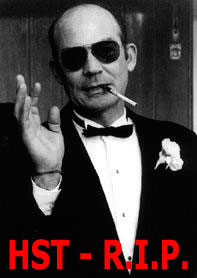
HST -- The World's First Blogger

HST - R.I.P.

A post from almost two years ago:

I wrote in my little private paper journal a while back, writhing in a fit of angst and doubt about whether We will turn It around, "...and where's the Hunter S. Thompson of my generation? Probably off somewhere blogging..."

Kos is on my wavelength for this one too -- "Hunter S. Thompson -- the world's first blogger." -- and it's a meme I'd like to popularlize. As I wrote:

More than any of the excesses or eccentricities of his life, Thompson is a widely known and loved public figure because he has got game with words and ideas and the human spirit. If he were less of a Freak, he'd probably still be a best-selling novelist (or perhaps a successful politician). Instead he's what every lefty blogger wishes they were, someone who took the notion of first-person reportage to the limit and emerged with shining gems of quality and insight.

Beyond the quality of his prose, the thing that I found so consistantly compelling about HST was his committment to the ethos which underlied his existence. The successful outlaw is more moral in his or her own way than the straightest by-the-book player ever could be, for they live by their own code. It is taking on somewhat more responsibility to carve your own path. More dangerous, yes. More descructive, possibly, but finally more brave. Down the path less traveled (or off into the wilderness) lie the greatest treasures in life. May we all live as great explorers and tellers of truth.

Read More

Tags: 

New McCarthyism?

Read More

Tags: 

Pages