Poppin' and Lockin' About Tagadelic Aggramatron Popular Fresh
Loading

postmodernism

I’m feeling it. Well, actually, I’m totally fucking exhausted to the point of being goofball jittery, but sitting here on a borrowed bed after spending a week dancing along the edge of what I can really do as a person, I’m all strung out, a little hung over, but sizzlingly alive. It’s hard to articulate. Words fail, but General Tso’s Tofu provides.

Earlier this week I visited with Bill, my Pa, my step-father, father of my sister, who was around the house from when I was about three until I left home and did me a world of good in-between. He and my mom had a really interesting relationship, one which reached a romantic coda when I was a teenager (and was ergo semi-oblivious to this, or perhaps just too self-absorbed to care) but they stayed together as a logical family unit until my sister left for college.

He’s married now to a wonderful artist named Patti — hence the domain name — who’s lives most of her life out in DC, and who he (and my mom) have been friends with since they were wild and young. Yeah. Life is strange that way. I remember meeting Patti when I was a kid in Iowa when we were out there one summer on the farm, her and her then-husband Skip — who was part of the wild and young thing too — come out to visit and break the news that Skip had cancer. Skip died. We all went to his funeral in DC. They played The Circle Game.

Patti is dying now too. Same cause. All things considered I was impressed by how well she’s holding up, and Bill’s doing a stellar job of taking care of her, but it’s clear where things are going and it was bittersweet seeing her; made me feel sick to my stomach to say goodbye.

And it feels weird and advantage-taking to say it, but that very real, heavy, pressing reminder of just how finite our time on earth really is is why I’m feeling the way I do now, which frankly I’m enjoying. Contrast reveals, and the old words sing: Life Is Holy And Every Moment Precious. Thanks, Patti.

Also fueling the fire is that I’m reading Dave Hickey‘s Air Guitar, and I feel he’s a kindred spirit in the over-use of five-dollar words and full-hearted embrace of the Public. He made it ok, seems to be happy and shit. That’s always nice to see.

To sum up, post-postmodernism recognizes and embraces the relativity of all things, understands that meaning is born from a web of associations, and takes away from this not just the apple-pie wisdom that “life’s what you make it,” but also a critically empowering lesson in terms of how things get made. We are procedurally literate. We see and feel the romantic keen of Meaning, and fill ourselves with the knowledge of it’s construction like so much Holy Ghost Power.

Everything is a choice, so, in the words of Jimmy Carter, “Why Not The Best?“ There’s just no time for anything but Love, but Action, but Brotherhood, but Glory. Anything less is marking the days, waiting on revelation. Nothing ventured isn’t just nothing gained; it’s really a gigantic cosmic loss.

I go back and forth on the Zen question, about what can and can’t be actively done or achieved through intention and attachment, what you might call “direct action” in life. It’s tricky. As they say, when the student is ready the master will appear, and all the great things in life will come to you in unforced moments. In the words of my mother, the universe is not a tease — but you have to let yourself go to it as well.

You have to be ready, to be hungry, to be willing to take a chance, to give yourself permission to speak freely. You have to have faith. You have to embrace your shadow self. You have to keep on plugging away.

This is a struggle for me just like it is for every other poor confused soul who braves the world free of easy fictions and light on the self-delusion. We all long for the comfort of certain knowledge, are envious of those who appear confident and calm. I know well enough that other people see that in me, and in this I take some solace, because it lets me assume that everyone else is really just as uncertain under the hood too. But that doesn’t make any of this feel less urgent. Gotta make something happen. Gotta believe. Got to be Free.

It’s scary to be here — to feel my spirit opening, like I could fall in love again, like I could get my heart broken — but scary in a good way, the Allen Ginsburg way, the way that lets you know you’re really on to something.

To be honest I have no idea what that something is, or where all this is headed. It’s just getting started, I think, and I want to try and Go With It even if I’m not sure what the goal is. I feel like my thirst for long-term/big-picture clarity holds me back and away from the thrum of the present. It’s a cop out.

So I’ll go with the flow, with the excitement. It’s keeping me up at night. Ideas. Philosophies. Business plans and political schemes. Thoughts of women and dreams of paradise. This is why they pay me the big bucks.

Speaking of which, in the meantime there’s still a shit-ton of work to do, a lot of boxes to check and a lot of miles to travel. It’s the hard yards from here until the end of the year, and maybe even a little into January, but after that… I have a feeling that 2008 will be a Whole New Thing.

Well, I’ve been stewing, and now I’ll be spewing.

We of Cinema
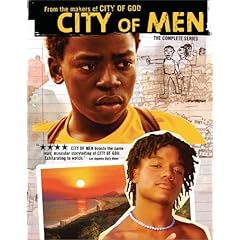
City of MenA while back I got this great DVD from Brazil called City of Men, something of a follow-on to the brilliant film City of God, which delves into the lives of children in a particularly infamous favela.

The series is significantly more positive than the movie. It doesn’t shy away from grit or violentce, but it does manage to pull out a lot of beauty by taking a wider angle and showing the holistic culture and community. It’s really fantastic. You can buy it from Amazon if you like.

One of my favorite aspects of the series is the way in which many episodes include “live” camcorder shots of/by the kids, archival footage (which may or may not be real), and also documentary-style interviews. This form represents next-gen postmodernism at it’s best: a reconstructive narrative. One of the more humorous moments comes in an episode where the two protagonists take a trip to Brazillia to hand-deliver a letter to President Lula, under the auspices of an NGO who’s director has the kids film things in the favela. They’re riding on the bus with the camcorder, talking about how important it is to get on tape so the director can “make her gringo bosses happy.”

In reality, the series comes from just such an organization: the Nós do Cinema project in Rio, which is overseen by Kátina Lund, co-director of City of God. Basically they started doing media and acting training in the favela in order to build the cast for the movie, and the organization was such a hit with the people that they kept it going afterwards.

The two principle actors in City of Men Douglas Silva (Acerola) and Darlan Cunha (Laranjinha) were participants in this program. Both played central characters in City of God. They, along with most of the other child actors, are quite talented, and it’s really something to watch them grow up over the four years of filming.

I really like the idea of Nós do Cinema. It is in keeping with the absolutely fantastic Brazilian pedagogical tradition of Paulo Freire, who’s Pedagogy of the Oppressed I discovered by way of Auguso Boal and his Theatre of the Oppressed, which I studied a bit at NYU. In brief, Freire (much like my man John Dewey) asks us to ditch the “banking” concept of education — in which the role of student is to be “filled” with “facts” — and stresses the need to develop indigenous forms of intelligence, critical thought and articulation.

For me, these ideas echo many of the more positive aspects of my own non-traditional education; they have come to form a core set of values for me in evaluating the world around me and in thinking about how to improve the human condition.

The Means of Communication
I’ve repeated the notion so often that it feels tired to me, but it seems undeniable that future human progress depends on the continued democratization and decentralization of our means of communication. We need to talk more and more meaningfully to more of eachother. This isn’t your average cliche call for increased dialogue; I believe we actually have a chance to make a quantum leap in terms of our global communication, and significantly improve the whole world situation in the process.

To be sure, human progress also depends on a lot of other more tangible things — things closer to the Old Man’s means of production — being more equitably and efficiently parsed out as well. However, I and many other see strong rights and freedoms and powers around information to be fundamental, even necessary, pre-coursers to a more equitable distribution of material wealth; media justice as a means for social justice, if you will.

Indeed, without the critical ability to independently communicate, we’re condemned to being herded (for better or for worse) by our social elites, and I don’t think that’s where we want to be. Recent history shows the weakness of elite/centralized control structures from the Soviet Politburo and their sham command economy, to our own decadent political establishment in Washington and the corruption and failure that’s come from ever-greater corporate consolidation.

Indeed, there are few if any established institutions which have not seen their credibility degrade in recent years, including the press and religious institutions. And not without reason: they’re failing us. If we’re to navigate the perils of the 21st Century with any hope of making the world a better place, let alone preventing catastrophe, it’s inarguably necessary to explore new forms of organization and interaction. What we have now is not working.

People are not stupid. They know that things are getting worse in the world, but I think most people — myself included — feel largely powerless. And, individually, we are. Certainly there are all manner of important individual acts that run along the theme of “think global, act local,” and yes it’s a good thing to conserve and recycle, to be kind and engaged with your own community. However, more is needed, and the first step towards getting more is to overcome that sensation of individual helplessness by connecting with like-minded people to engage in larger-scale projects.

What Do We Imagine?
One of the reasons City of Men impresses me is how well it communicates a distinctly different culture to my own, better than any foreign film I’ve seen. And in spite of the omnipresent threat of drug-traffickers, crushing poverty, disintegrating families, etc, the cultural “message” of the show is overwhelmingly positive and attractive.

I think a lot of this comes from the strong sense of community that’s carried though the show, the sense of camradre and shared ownership of the physical and social environment. The US is very much a dog-eat-dog place, excessively individualistic, competitive and fearful to the point of paranoia and genrally lacking in public/community space. We’re missing that quality of fraternity, to go with our liberty and (supposed) equality. Traded it in for the pursuit of happiness we did. Kind of a shame.

Something as simple as Acerola’s favela funk-dancing group doing a little routine about peace and love stikes me as something that would seem out of place, if not laughable, in a mainstream American context. As someone who’s a big proponent of both peace and love, this is a little disheartening.

It strikes me in my art-heart that a lot of our problems are bound up with the crass commercialization of our culture. Human beings, including those who create, tend to have a 360-degree range of experiences and expressions. While everyone’s got their own style and I’m all for darkness, blood, sex and profanity, it’s the need to fit into economic niches or appeal to marketing segments that drives the mindlessly low common denominator of so much contemporary culture.

On the other hand, if people didn’t buy mindless inhumane and degrading products at such reliable rates, this wouldn’t be an issue. There are cycles at work in culture, just like in family life, and they can spin either upward or down.

So the question really is, what do we imagine, and who are “we” in imagining it? Recently, the we has been a pretty small cabal, and the what has largely been whatever will sell. That’s changing, and increasingly quickly, as the media industry becomes one of the first to come apart under the pressures of massive consolodation, like some black hole imploding.

Like the T-shirt says, it’s fun! In spite of “the coarsening of our public discourse,” as the circle of participation has widened and more people from more walks of life have become cultural producers — whether we’re talking independent film, hip-hop, blogging, or Nós do Cinema — there have been some great results. I find a lot more to like in the contemporary cultural scene than I do in the sanitized past of Hollywood and Broadway, and it seems harder and harder to pass of rank bullshit in the public square these days.

This trend of decentralization, the decline of gatekeepers and rise of independent producers, also brings to life the great hope of a more equitable cultural balance: a civilization which truly exists in a state of conversational interconnection rather than some kind of internally constructed hegemony. It’s been a long road out of serfdom, but it seems like we’re getting close to a watershed.

Jaded skeptic that I am, I still hold out an innocent, faithful belief that people will do right more than they’ll do wrong. It seems to me that the more we get people into making culture for, of and by themselves, the closer we’ll get to a just and equitable world, and the better chance we’ll have of living in peace.

Rolling over the clouds, chasing the sun, looking back at the expanding crescent of the earth’s shadow in the sky behind, it hits me all over again.

I’m going to have to find my own way.

And the only way that works is if I’ve got the pride, ego, confidence, vision or whatever you want to call it to make it happen on my own terms. I spend a lot of time second-guessing myself and guarding against hubris — a well-known tragic flaw — but it’s too late at this point to hope that some ordained path will mystically arise. I’m not destined to fit into a “career track,” too independent (cocky) to go into apprenticeship, and I’m certainly not going to find some guru to hand me down my purpose on a silver platter. That much is clear by now.

My experience as a performer (and with a few other things) has given me a bedrock belief in my power to create moments of sublimity, to temporarily transcend the normal boundaries and limitations of humanity and make contact with the divine. It’s real, glorious even, but also ephemeral. You can’t live it, although you can do your damnedest live for it, by it, and through it. For better or for worse that’s how I roll; seeking the edge.

This past year and a half I’ve struggled with my rambling nature, trying to settle down in one way or another. It hasn’t really taken. I’ve learned a lot about myself and gotten into some really great things — and so I have no real regrets — but I’m coming to the conclusion that now is not the time for me to put down roots in the conventional sense, and indeed that “conventional sense” may simply not apply.

I’m not opposed stability per se. Good things last, and I’m a lover of quality, but reliability and routine have no appeal to me as ends. Security is a desire written into our DNA, but like a lot of those hardwired things (“I’ll fuck anything that moves!”) it’s irrational and insane. I like trust, which is related, but again I tend to find my way through to that on the top end — through quality and exceptionalism, not predictability. I don’t really trust that which is predictable; to be honest I relegate it to a lower order of consciousness.

Sometimes I worry that this is just me wrapping a semi-intellectual conceit around the old “live fast die young” rag, that once I lose my edge (or my hair) I’ll change my tune, and by then it’ll be too late (“There goes Koenig, a broken old man”). But I don’t think so. I’ve made my life what it is largely on my own initiative and pluck, and that’s come from my trusting my gut feelings. This is one of them.

So what does it mean? I’m going back on the road? Hardly. It’s a shift in perception more than anything else. Actually, it means taking on more responsibility, that taking my own bullshit somewhat more seriously, owning it. Once again I return to reclaim the dignity of my own experience.

I won’t reach my destiny by trying to pick a career or an industry or a scene, by being a businessman or an artist or a politician or an engineer or an outlaw. It won’t happen by finding the right place to settle, or even the right woman to settle down with either.

Indeed, I’m coming to believe (again) that I must eschew such narrow thinking. My ambition involves all these things and more, but reducing it to single constituent parts — much as it appeals to my inner project manager — pulls the life right out of the system. The whole is more than the sum, and a plan is just a list of things that don’t happen.

But as the general said, plans are useless, planning is essential.


So the above was written on the plane ride back from NYC to SF, where I stayed for three days checking out the office and getting some things done with my partners. I drove home Thursday afternoon through some of the most intense balls-out springtime environments I’ve seen yet.

The vineyards are sprouting up green and the hills have yet to dry out and go golden. Flowers are everywhere, and as I rolled down out of the last batch of hills the coastal lowlands of Humboldt Bay literally reeked of organic tumult, some musky and specific mixture of chlorophyl and cow manure.

It brought back a flood of memories, this smell. Baseball in Iowa. Hiking up the hill on the Four Winds Commune. Driving up from Roseburg after a day trying to sell vacuum cleaners. The Oregon Country Fair. A pretty mixed bag, really, but all full of wonder.

Last night me and the Alaska Redman cleaned out my stash of Czech Sunshine, an idea that’s been in the works for a while, but got activated as a spur of the moment thing. We’ve got a little history here, going back to age 19 and three hits of blotter a piece shared with our old Waldorfian comrade Mr. Jacksaphone. It was a giddy teenage trip, but things went south in the wee hours and I spent the time from three to six AM holding old Red down on the floor so he wouldn’t do himself harm. Which is what friends are for.

Eight years later and on a lower dose we have a better time of it. No king-hell revelations or visits from another planet, but plenty of postmodern laughs — how many cheap pieces of glass do I have to give you to get this fire back? — and a chance to blow out some mental cobwebs and get another perspective on things.

The best idea we came up with was to put forward the notion of The Nothing (the villainous force from The Neverending Story) as being behind all manner of creeping corporate evil. Kids getting lost in My Little Pony fractals. “When we retire, Clara and I are going to take trips like this all the time.” Vote Nothing in 2008!

In the morning we have a nice chat, again around coming of age issues, the end of childhood, the notion of family, careers, locations, communities. It sometimes seems and impossible task, getting it all together. I’m no closer to a grand plan or vision, but tired as I may be I’ve got plenty of hope.

I loves me some Battlestar Galactica. Julia and I watched the last two episodes of this the third season and they did not disappoint.

My three favorite things about the show are:

  • Its embrace of the ability of science-fiction as a form to explore topics — philosophical, moral, existential — which are too abstract and heady for conventional drama.
  • Its specific implementation of the above vis-a-vis issues of politics and governance.
  • Its unrepentant postmodernism.

That and it’s got a cast that looks good and can act. Not an easy thing to put together.

The show is at its finest when all three of the above are working in synergy. For instance, the opening of this season which re-purposed and inverted the conventional political language of the war in Iraq. Similarly, they managed to work in “serving at the pleasure of the president” in the last episode. That’s some foresight.

My one quibble with the finale was that they made the Bob Dylan reference so damn obvious. There was a more subtle nod earlier, which I got and appreciated, but it sort of took the fun out of it when they made it all in-your-face.

Anyway, I’m glad that Zephyr bugged me about this enough to start watching it back in the dark days of December 2004. It’s been a pleasure ever since.

Syndicate

Syndicate content