Poppin' and Lockin' About Tagadelic Aggramatron Popular Fresh
Loading

politcs

I don’t want to offend anyone with this post, but I might. C’est la vie.

So, one of my newest and favorite blogging pleasures is The Brody File from the Christian Broadcasting Network (aka parent org of The 700 Club). Mr. Brody is a pretty good writer, and he’s covering politics — mostly the GOP presidential nomination process — from an angle distinctly different from my own.

I find this kind of perspective valuable. I have been generally digging on The Right’s Field, which is on a similar beat, but that’s written by people who are on my side and in some cases my friends, so it just doesn’t have the savory flavor and nuance of getting into the head of the Other.

Anyway, reading the Brody File seems like a good way to get in touch with mentalities that I don’t often encounter socially, which is worthy even (especially) when I may disagree with said mentality. Keeps things nimble and limber. I wish there were a similar blog — meaning readable and relatively non-propagandistic — that was on the “Bomb Iran” tip that most GOP candidates (save Ron Paul) seem to be rolling on. That would be tight.

Back to the point, in the first Republican debate, three of the ten candidates stated that they did not in fact believe in evolution. The rest — especially the great tan hope Mitt Romney — have been doing the politician potty-walk ever since, and Brody has been following it, for obvious reasons.

In this post he publishes some letters from readers presenting arguments for the creationist viewpoint:

First as to the literal 6 days of Creation- on day 3, God separated the land from the water. This was in preparation for when He created vegetation that same day so that plants could become rooted. On day 4 He created the sun which was essential for plant life because they require photosynthesis, provided by the sun. In addition, He created insects on day 6 to include bees which are necessary for pollination of many of the plants that are food sources. It is impossible for plants to survive without the process of photosynthesis produced by the sun. How could God create plants and create the sun millions of years later, when the sun is the vehicle by which photosynthesis is possible? The time between days had to be short since plants and the food they produce were dependent on the sun and insect pollination. Without plants, no animal life could survive. So the days of Creation had to be literal 24 hour days.

Parsing that, it sort of blows my mind that someone really thinks this way. Now, I’m sure my vague agnostic notions of physical existence, the origins of the species, and my dubious ontology of “power through belief” and “social interaction” would probably blow whoever wrote that’s mind if I tried to spell them out. People do believe in different stuff, it’s true, and we can all get along anyway. Hooray pluralism!

However, what strikes me about this (and about other arguments I’ve seen for creationism) is that there appears to be a level of complexity or scale where direct understanding fails us, and at that point Reason has a way of checking-out, or becoming disconnected from reality. I think this is probably natural. I mean, the level of complexity where it becomes difficult to impossible for a human mind to completely track what’s going on is not very high; certainly many orders of magnitude away from literal comprehension of geologic time, molecular activity, or the course of human events in a world of billions (let alone a nation of millions or even a city of thousands).

We deal in abstractions. It’s one of the things that seems genuinely special about Human Beings. Existence is unimaginably complex, and so we have shorthands and stories for all sorts of things, from Newtonian Mechanics to creation stories. There’s no way around this, though some abstractions are clearly more useful and/or externally verifiable than others.

We’re rational creatures too, another thing that’s special about us as far as we know. We like our abstractions to be true, or at least consistent and helpful in making our way through our lives. We appreciate order, and delight (at least initially) at being able to predict and control things.

We also like other people to agree with us. In this, rationality helps, as it tends to hew to the empirical ethos of the scientific method (“do you see what I see?”), but so does prejudice. All ideas are, at some level, social, meaning things get mighty sticky in the execution.

The above quote illustrates a really fascinating collision between rational and mystical abstractions. There’s a sort of agricultural shorthand, which is a little sloppy but close to what a real man or woman of the earth would tell you about what plants need to live, and there’s the deep-seeded belief in a story about how the Earth came to exist. These two are combined in a pseudo-logical argument which (QED!) “proves” that the days of the creation tale were literal 24-hour periods.

These kinds of pseudo-logical complexes are common to most mystical traditions, from Scientology and its Dianetics to the power-structure and rites of Catholicism, or the general concepts of shamanism, or psychedelia for that matter. There are things people can do, the mystic suggests, which can alter the course of events. Mystically. And there’s a code to this, maybe written in a secret book. As my man Samuel says, Witchy Shit; here’s some blood to drink.

At the same time, it doesn’t seem like there’s any real problem holding truly rational and mystical abstractions in one mind. Many great scientists (from Darwin to Einstein) were also religiously observant, even devout. On the flip, there are plenty of atheistic or non-religious people who believe all sorts of irrational things, though many of those beliefs — I’m thinking of conspiracy theories here — do approach the level of mysticism.

The problem, such as it is, seems to be that our rational and mystical threads become entangled, and when this happens beyond the margins of what we ourselves “know” or can immediately grasp — what’s within the reach of our scale-comprehension — whatever we consider common sense (which Einstein called “the compendium of all prejudices instilled by the age of seventeen”) will probably win out. There are few Christians who would deny the reality of Nuclear Power, but the follow-on conclusions reached through the same scientific principles, e.g. radiological dating, are unacceptable. Because the linkage between the real/graspable thing (electricity!) and the implied conclusion (the Earth is billions of years old) is beyond the understanding of most people, it’s just the word of some guy called “a scientist” vs. common sense.

What I’m interested in is how the stack of abstractions that we use to make sense of reality gets built, how it functions, and how some abstractions seem to have the effect of extending the scale of our comprehension, while others do not. It seems to me that there’s a way of evaluating the worth — or perhaps the persuasiveness — of an idea in there somewhere, and that it might be a good one.

Also, how is it that some people seem to be able to scale their understanding further than others? Is this learned, and if so how?

Anyway, lots of food for thought.

This is a smart move; electable is the word that comes to mind.

She should be getting it out on YouTube.

With Democrats set to take over the congress in 2007, there’s obviously a lot of interest and wonder in the prospect of impeaching President Bush. I’m not a fan of this idea.

There are several reasons why I don’t think it’s especially great goal to pursue which I’ll list, but I want to point out that the idea that impeachment is “off the table” is clearly bunk. It’s in the constitution so it’s on the table, the question is whether or not this is something that should be pursued specifically. I think not.

Why? Well here’s a list of my reasons:

  • President Cheney: you can’t impeach them both at the same time, and the notion that major policy changes can be brought about this way seems wrong. We’re not impeaching our way out of Iraq. It’s rather more difficult I’m afraid.
  • Vengeance Is Ineffective: while there are strong legal arguments, and a streak of boy scout civic duty, my read is that much pro-impeachment sentiment is motivated by a desire for revenge, to strike back for all the harm Bush has caused. I understand this and I feel it myself, but it makes me think twice. What’s the practical outcome we’re looking for?
  • There Is No Absolution: related to my feeling on vengeance, I also think a lot of impeachment boosters see this as a chance for the nation to absolve itself for the mistakes of Bush. I also understand this motivation, and feel the desire to clean up our reputation too, but I think its simplistic and naive to think that a single act will do this.
  • It’s Costly: time and energy spent on this won’t be spent elsewhere, and undertaking this as a strategy will generate significant opposition and inevitable backlash.

All this leads me to a cost/benefit analysis that says setting out with the explicit goal of impeaching the president is not a good idea. I think investigation, oversight, testimony and hearings are in order, but I also think that repudiating the Bush Legacy is a much bigger thing than punishment.

Putting the Bush Legacy down is the work of decades. Setting impeachment as a goal (rather than allowing it as a consequence of this wider effort) is a grave error.

There’s a possible course of events in which congressional hearings and grassroots activism build support for this over the next six months to a year, and impeachment actually becomes a national consensus. I think this is unlikely, and impossible to manufacture, but it would be a good thing in this context, especially considering how it would play in with the 2008 election.

However, if you’re looking for tactics, holding mass anti-war rallies is probably going to be more effective than agitating for impeachment.

Politics is the Art of controlling your environment. It’s an emotional process, but ultimately it is about outcomes, not how you feel.

The internet is good for politics, a welcome addition to aging machine organizations, broadcast campaigning, a moribund press corps and the “infotainment” of 24-hour cable news. Even though many lament the “coarsening of the discourse” and the sharpness and vitrol you can find in the online “fever swamp”, it’s not as if this is actually new. Talk radio is famous for this, and countless other subcultural media — mostly on the right, but some on the anarchist or communist fringe — have been at it for years. It’s just out in the open now, which, if you want to address the problems of divisive politics, is a necessary first step.

The internet is good chiefly for two reasons:

  1. Lower Barriers to Entry and Decentralized Authority: basically anyone who meets a minimal (and increasingly ubiquitous) set of requirements can take part. This widens the circle of participation, prevents or at least counteracts stale and unhelpful assumptions (aka “conventional wisdom”), and creates more competition to deliver good results. Win win win.

    Also, the open playing field means that authority — and by that I mean both who’s “an authority” on something as well as who’s the boss — becomes decentralized and harder to work for. You’re an authority because you put out something that builds a community of consensus, and in an open system it’s hard to do that without transparency and hard to build a consensus around lies if you can’t be opaque. Again, people will and are using this for evil as well as good, but the good is far more prevalent, and net/net it’s a much better ecosystem for civilization than the Hurst empire.

  2. Transparency and Accountability: As mentioned above, getting the hot air out in the open, while not pretty, is a good/necessary thing to move forward. There’s nothing to be gained by keeping this stuff underground. Lance the boil. Let the puss ooze.

    Transparency also drives accountability, which critical for democratic systems to work. Check out this roundup of posts by right-wing megastar Instapundit on the Iraq War. It’s cherry-picked for sure, but the truth is that this guy shouldn’t have any credibility until he can explain all this nonsense. We’ve all made wrong predictions, but looking at these collected works, it’s hard not to see propaganda. This is a new thing, and it’s going to cause a shakeup, both in terms of exposing people who are consistently unhelpful, and also in setting more realistic expectations for how often any one voice can be correct.

This has been your daily reminder to believe that things are getting better. Enjoy!

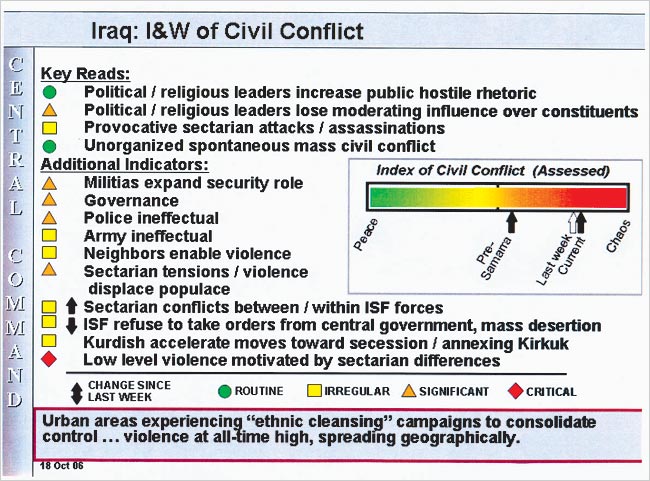
Iraq Chart
I was against the war as far back as Fall of 2002, when it was clear that the Bush administration wanted it. I always thought it was a foolish exercise in hubris and greed. But my and millions of others protests were dismissed as “a focus group,” and it went down anyway. And so here we are.

We’ve got to end the occupation. It’s not working. It’s not going to work. In fact, it’s making the situation worse.

Ending the occupation doesn’t mean trying to dodge any national responsibility. It doesn’t mean isolationism. It doesn’t mean “cut and run.” It means making the only moral choice we’ve got left, and taking to first step towards bringing down the curtain on this misbegotten American Empire.

We have two options: we can end the occupation in a process we have some control over and attempt to foster a more effective (read: international) means for helping the New Iraq find a balance, or we can wait until we can simply no longer afford to maintain the empire, let the permanent bases we’re building be overrun, lose many more lives, kill many more people, and have nothing to show for it but more blood in the sand, more debts and more enemies.

Go vote next week. It won’t solve everything, but it will help.

Syndicate

Syndicate content