| Outlandish: The blog |
| About: Who is this guy? |
| Life: The adventure of a lifetime |
| Art: My church |
| People: Make it worthwhile |
| Politics: The art of controlling your environment |
| Work: Necessity, purpose, honor |
| Contact: Only connect |

|

|

|
|
Outlandish Bulletin: |

|

|
Vintage Outlandish!
This Content From 2003 (or earlier) see index
| [outlandish] | [Dean2004] | [rants] | [essays] | [values] | [politicalblog] |
(Political Ideas Less than 100% Baked)Internet Empowerment The web was built fundamentally around the idea of access and extensibility. HTML data can be digitally translated into various media, enlarged for people who don't see well, spoken for those who cannot see at all. Pictures of text do not have this capacity. They have no meaning to their digital natures: it's just 1s and 0s. HTML can be localized, displayed in other languages, other character sets, transported onto a cell phone, accessed on ancient terminals, cut up and sewn back together. Not so with images. HTML (and the associated technology framework that lets you view it from your home, office or many other places) puts the power of how information is displayed into the user's hands, a first. The web is a truely bi-directional means of mass communication, also a first. These implications are only beginning to be felt, and the changes that could be wrought on the worlds of media, commerce and culture are potentially huge. Why? Because they empower the user, put strength in the hands of the consumer. They turn the passive passtimes of watching TV or reading a magazine into active actions. But this power implies responsibility. You're trusted to make the most of it at your end. That's why I nag people about upgrading their browser: it's your responsibility to support medium. Using an old browser (and letting others do so when they need sacrifice nothing in order to upgrade) is striking a blow against the ability of the medium to be revolutionary. I really believe in this. The front page of my website should bitch at you if you're using netscape 4. With mozilla, you have a standards-compliant, beautifully built, highly efficient user created and supported piece of software. It works the way we want it to, and that's why it doesn't display pop-up ads. Blocks them. Neat, eh? The real pitch here is that when you rely on the old ways of doing things, you hold progress back. Doing things the new way is harder in some ways, easier in others, but it opens up possibilities, lots of possibilities. And we need those possibilities. Today's media environment is diseased, harmful, draining. The relationship between most people and mass media is one of opressor/opressed, creator/consumer, active/passive. The internet represents the possibility for participatory mass-media, and that why I want to help us all get on to the Next Step, this time with the people in control. Might sound geeky or naive or even communist, but I believe the power of science and technology can have a significant positive effect on society. Related outlandish contenet: |
| [outlandish] | [Dean2004] | [rants] | [essays] | [values] | [politicalblog] |
Blogroll: Stuff I read often, other blogs I know and love.
ERROR: http://rpc.blogrolling.com/display_raw.php?r=c9e57b8bb9c852acff2931f6bb75d3e0 is currently inaccessible* denotes freshness
Trips
8/02/03
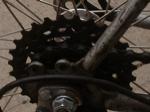
Big Wheels in Berkeley
I scored a set of west-coast wheels today at the Ashby BART station flea market. It's a very tall schwinn road bike, black, deceptively heavy but smooth-riding. Thirty-five dollars to boot. I oiled and cleaned the works, dialed in the bakes and took it out for a shake-down cruise immediately. Nice riding on a beautiful saturday, realizing how out of shape I am as I wheezed my way though the hilly area behind the Berkeley campus.
After about an hour I started to get the swing of it. Made some minor mechanical adjustments (including a free wheel truing at the bike collective on Shattuck), drank a few liters of water and started finding my groove, cruising up and around and ending up with a beautiful view of the whole bay. The roads here are not kind to the speed inclined -- too many stop signs and crosswalks and lights -- but it was good to get out and proj for a while. This changes my summer dramatically.
Filthy Lucre